Before reaching production, every industrial product is designed using specific software: in this sense, a key benchmark is represented by CAD software, a technology that has assisted companies and businesses in industrial item design, product development, and building design for over thirty years. CAD is widespread in Europe; suffice it to say that in Italy and Germany alone, over 2 million companies use it daily.
In the product development process, using CAD—which requires professionally trained operators—can take up to 50% of the total time; furthermore, the software demands a high level of staff expertise and therefore high costs for companies. Until now, that is, because a group of young engineers under 30 promises to revolutionize the design sector through the startup NEOCAD, among the first in the world to associate generative artificial intelligence with CAD, making the design process for industrial products, artifacts, and buildings faster, less expensive for companies, and more accessible to operators. This innovation led NEOCAD to be selected by ZEST Group through the HabiSmart program—the accelerator dedicated to PropTech and Sustainable Construction within the CDP Venture Capital SGR National Accelerator Network—as one of the six most promising startups.
But why is it correct to speak of a revolution in design with NEOCAD? Its operation is similar to the generative artificial intelligence that powers popular platforms like ChatGPT, to cite the most well-known example. In fact, NEOCAD allows for the creation of a 3D model from scratch simply by typing the desired product characteristics—dimensions, volume, and material—into a text prompt, rather than having the CAD operator draw them from scratch in the software. Once the digital CAD model of the product to be manufactured is obtained, it is ready to be exported and subsequently refined in the reference CAD software for industrial production, with significant savings in design time of up to 50%. This is in addition to a reduction in operating costs, which can decrease by up to 30%; no less important is the reduction of the human error margin and time to market—the time between the development of the digital model and final commercialization.
In addition to cutting costs and reducing time, the use of CAD for 3D modeling thus becomes more intuitive and efficient: “The future of industrial design is no longer just manual, it is generative. With NEOCAD, thanks to artificial intelligence, we instantly transform ideas into CAD models, redefining the
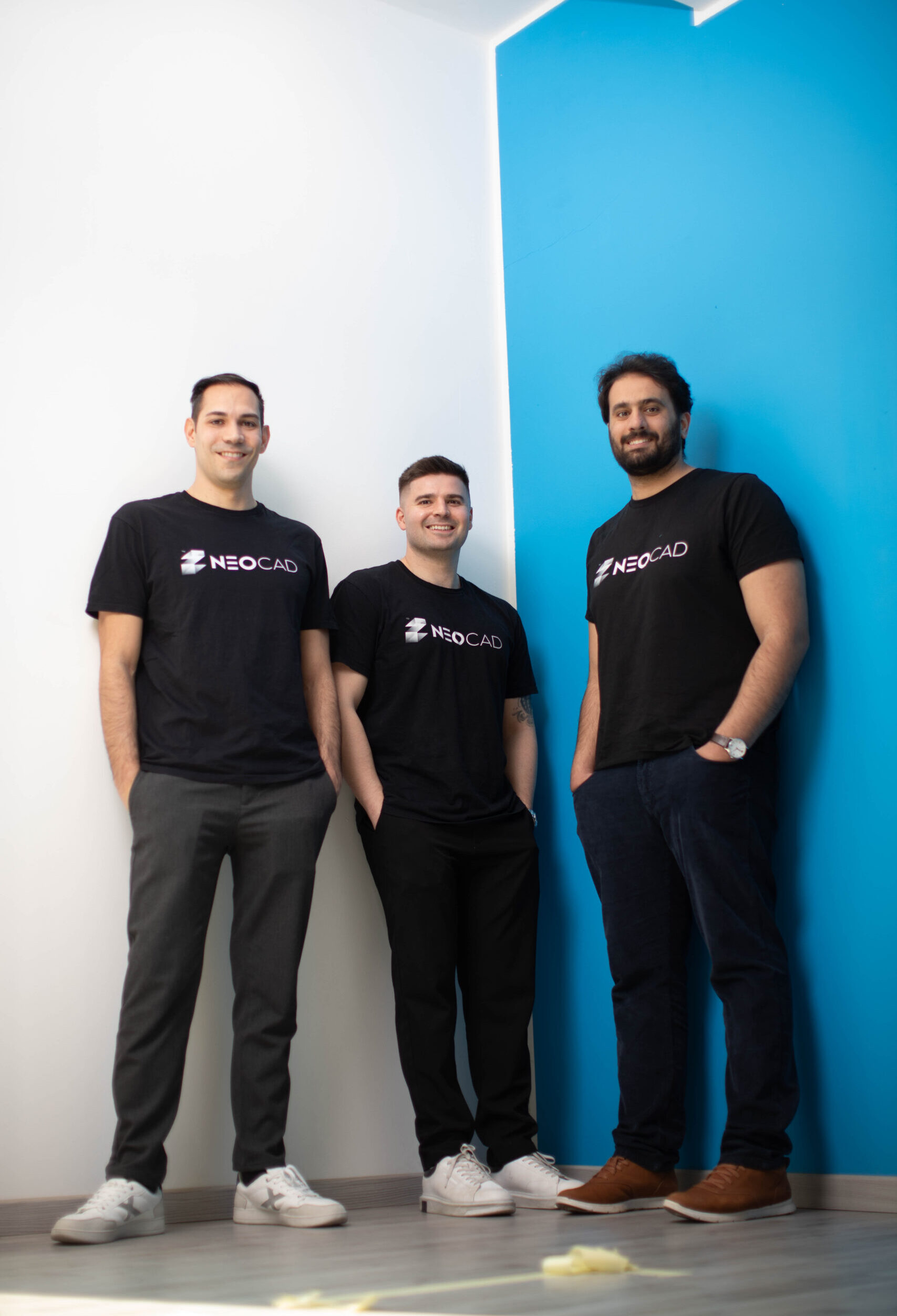
boundaries of innovation and creativity,” explains Luca Licciulli, co-founder of NEOCAD, who—together with Alessandro Toia, both under 30 with educational backgrounds in economics and management—had the revolutionary intuition for NEOCAD, which they were able to develop thanks to the invaluable engineering collaboration of the third co-founder, Ahmed Shahhat. “Any product, even a simple water bottle, is designed by engineers and developers using CAD before reaching industrial printing, which allows for the creation of the print shell from which the final product is then born,” Licciulli adds.
“With NEOCAD, we optimize and speed up the entire design process from the initial phase, from ideation to generation, reducing work timelines through the application of artificial intelligence. Despite the speed of change in this historical phase, CAD technology has not evolved with generative AI; therefore, our technology will not replace human work and creativity, but will serve as an aid, making certain decisive processes much more agile,” Luca Licciulli specifies. NEOCAD enters the Italian market with a cloud-based subscription formula, suitable for both the needs of freelancers and large companies, particularly in industrial manufacturing and the construction sector, thus allowing any user to access a ready-to-use platform where three packages can be subscribed to, featuring three different versions of the CAD software.